

window.dataLayer = window.dataLayer || []; function gtag(){dataLayer.push(arguments);} gtag('js', new Date()); gtag('config', 'UA-157086367-1');

About Remi Silva

This author has not yet filled in any details.
So far Remi Silva has created 1449 blog entries.

Will Housing Affordability Be a Challenge in 2017?

Will Housing Affordability Be a Challenge in 2017? | Simplifying The Market

Some industry experts are saying that the housing market may be heading for a slowdown in 2017 based on rising home prices and a jump in mortgage interest rates. One of the data points they use is the Housing Affordability Index, as reported by the National Association of Realtors (NAR).

Here is how NAR defines the index:

“The Housing Affordability Index measures whether or not a typical family earns enough income to qualify for a mortgage loan on a typical home at the national level based on the most recent price and income data.”

Basically, a value of 100 means a family earning the median income earns enough to qualify for a mortgage on a median-priced home, based on the price and mortgage interest rates at the time. Anything above 100 means the family has more than enough to qualify.

The higher the index, the easier it is to afford a home.

Why the concern?

The index has been declining over the last several years as home values increased. Some are concerned that too many buyers could be priced out of the market.

But, wait a minute…

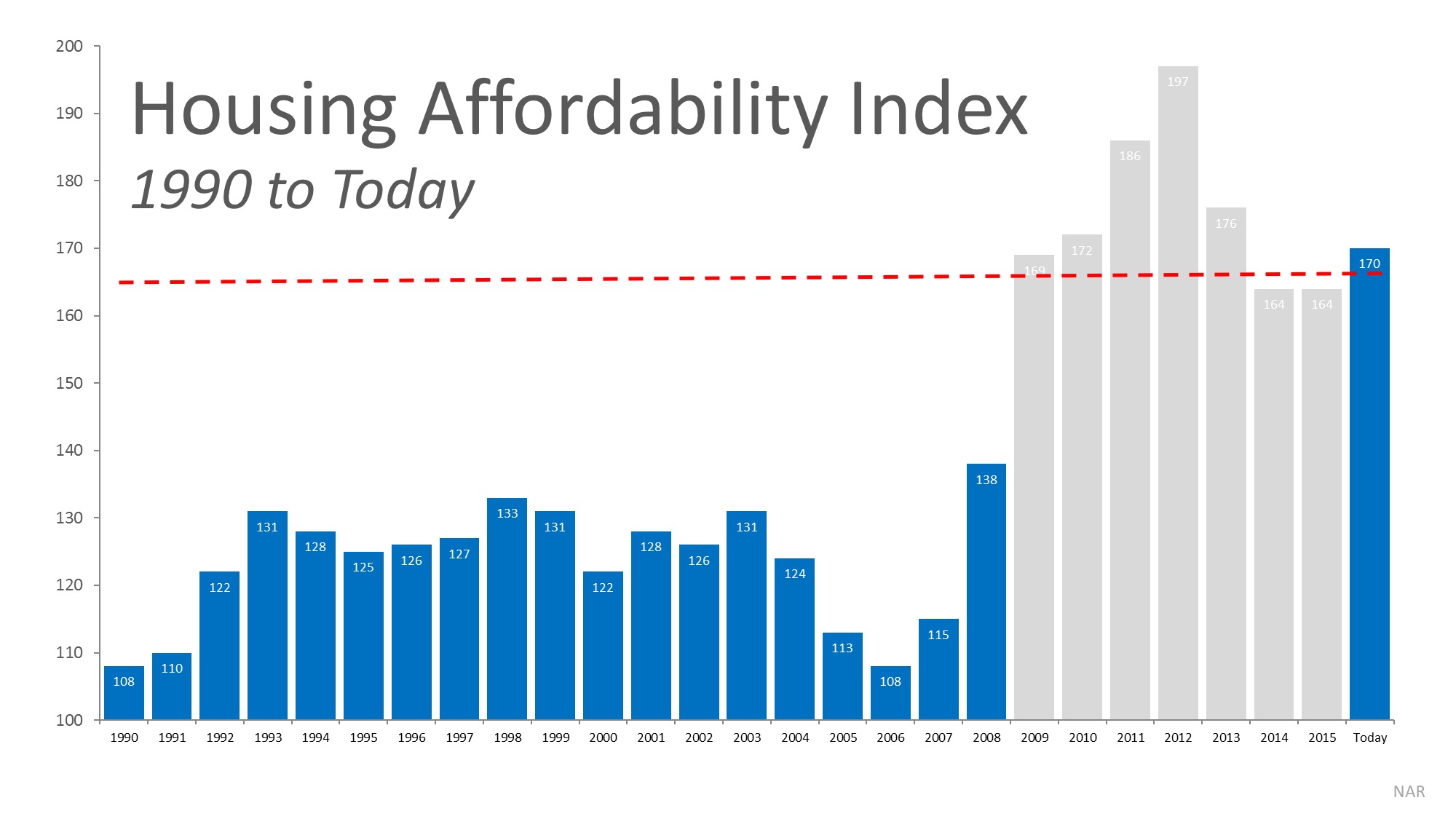
Though the index skyrocketed from 2009 through 2013, we must realize during that time the housing crisis left the market with an overabundance of housing inventory with as many as one out of three listings being a distressed property (foreclosure or short sale). All prices dropped dramatically and distressed properties sold at major discounts. Then, mortgage rates fell like a rock.

The market is recovering, and values are coming back nicely. That has caused the index to fall.

However, let’s remove the crisis years and look at the current index as compared to the index from 1990 – 2008:
Will Housing Affordability Be a Challenge in 2017? | Simplifying The Market

We can see that, even though prices have increased, mortgage rates are still lower than historical averages and have put the index in a better position than every year for the nineteen years before the crash.

Bottom Line

The Housing Affordability Index is in great shape and should not be seen as a challenge to the real estate market’s continued recovery.


Will Housing Affordability Be a Challenge in 2017?2017-01-19T11:00:00+00:00

What Would a Millennial Baby Boom Mean for Housing?

What Would a Millennial Baby Boom Mean for Housing? | Simplifying The Market

Recently released data from the National Center for Health Statistics revealed that 1.3 million Millennial women gave birth for the first time in 2015. There are now over 16 million women in this generation who have become mothers.

“All told, Millennial women (those born between 1981 to 1997) accounted for about eight in ten (82%) of U.S. births in 2015.”

The data also shows that this generation has waited until later in life to become parents as only 42% of Millennial women were moms in 2014, compared to 49% of Generation X at the same age. A Pew Research Center article discussing the data, points to social influences that may have contributed to the delay:

“The rising age at first birth is hardly limited to the Millennial generation. It has been a trend since at least 1970. Many factors may contribute, including a shift away from marriage, increasing educational attainment and the movement of women into the labor force.”

Do Millennials Want to Be Parents?

“While Millennials may be delaying parenthood, it’s not for a lack of interest in eventually becoming moms and dads. Members of this generation rated being a good parent as a top priority in a 2010 Pew Research Center survey.  

Some 52% said it was one of the most important goals in their lives, well ahead of having a successful marriage, which 30% said was one of their most important lifetime goals.”

So, What Does This Mean for the Housing Market?

As Jonathan Smoke, Chief Economist for realtor.com explained: “At any given time in our history, demographics would explain 60-80% of what’s happening [in the market], and we are in a period of time where Millennials make up a largest demographic group.” 

As more and more Millennial families are formed, this generation will shift their focus to providing the best home for their children to grow up in, the best school districts, and often to the stability that owning a home of their own provides.

Two-thirds of Millennials have not yet reached the average first-time home buying age of 32, as reported by the National Association of Realtor. The homeownership rate amongst Millennials has nowhere to go but up!

Bottom Line

Millennials as a generation have delayed traditional social norms until later in their lives. Whether getting married, having children or buying a home, the desire to provide for their family is still there, even if it takes a little while longer than it did for previous generations.

What Would a Millennial Baby Boom Mean for Housing?2017-01-18T11:00:59+00:00

5 Myths About Real Estate Reality TV Explained

5 Myths About Real Estate Reality TV Explained | Simplifying The Market

Have you ever been flipping through the channels, only to find yourself glued to the couch in an HGTV binge session? We’ve all been there… watching entire seasons of “Love it or List it,” “Fixer Upper,” “House Hunters,” “Property Brothers,” and so many more, just in one sitting.

When you’re in the middle of your real estate themed show marathon, you might start to think that everything you see on TV must be how it works in real life, but you may need a reality check.

Reality TV Show Myths vs. Real Life:

Myth #1: Buyers look at 3 homes and make a decision to purchase one of them.

Truth: There may be buyers who fall in love and buy the first home they see, but according to the National Association of Realtors the average homebuyer tours 10 homes as a part of their search. 

Myth #2: The houses the buyers are touring are still for sale.

Truth: The reality is being staged for TV. Many of the homes being shown are already sold and are off the market. 

Myth #3: The buyers haven’t made a purchase decision yet.

Truth: Since there is no way to show the entire buying process in a 30-minute show, TV producers often choose buyers who are further along in the process and have already chosen a home to buy. 

Myth #4: If you list your home for sale, it will ALWAYS sell at the Open House.

Truth: Of course this would be great! Open houses are important to guarantee the most exposure to buyers in your area, but are only a PIECE of the overall marketing of your home. Just realize that many homes are sold during regular listing appointments as well.

Myth #5: Homeowners make a decision about selling their home after a 5-minute conversation.

Truth: Similar to the buyers portrayed on the shows, many of the sellers have already spent hours deliberating the decision to list their homes and move on with their lives/goals.

Bottom Line

Having an experienced professional on your side while navigating the real estate market is the best way to guarantee that you can make the home of your dreams a reality!

5 Myths About Real Estate Reality TV Explained2017-01-17T11:00:02+00:00

Why Pre-Approval Should Be Your First Step

Why Pre-Approval Should Be Your First Step | Simplifying The Market

In many markets across the country, the number of buyers searching for their dream homes greatly outnumbers the amount of homes for sale. This has led to a competitive marketplace where buyers often need to stand out. One way to show you are serious about buying your dream home is to get pre-qualified or pre-approved for a mortgage before starting your search.

Even if you are in a market that is not as competitive, knowing your budget will give you the confidence of knowing if your dream home is within your reach. 

Freddie Mac lays out the advantages of pre-approval in the My Home section of their website:

“It’s highly recommended that you work with your lender to get pre-approved before you begin house hunting. Pre-approval will tell you how much home you can afford and can help you move faster, and with greater confidence, in competitive markets.”

One of the many advantages of working with a local real estate professional is that many have relationships with lenders who will be able to help you with this process. Once you have selected a lender, you will need to fill out their loan application and provide them with important information regarding “your credit, debt, work history, down payment and residential history.” 

Freddie Mac describes the 4 Cs that help determine the amount you will be qualified to borrow:

  1. Capacity: Your current and future ability to make your payments
  2. Capital or cash reserves: The money, savings and investments you have that can be sold quickly for cash
  3. Collateral: The home, or type of home, that you would like to purchase
  4. Credit: Your history of paying bills and other debts on time

Getting pre-approved is one of many steps that will show home sellers that you are serious about buying, and it often helps speed up the process once your offer has been accepted.

Bottom Line

Many potential home buyers overestimate the down payment and credit scores needed to qualify for a mortgage today. If you are ready and willing to buy, you may be pleasantly surprised at your ability to do so as well.

Why Pre-Approval Should Be Your First Step2017-01-16T11:00:00+00:00

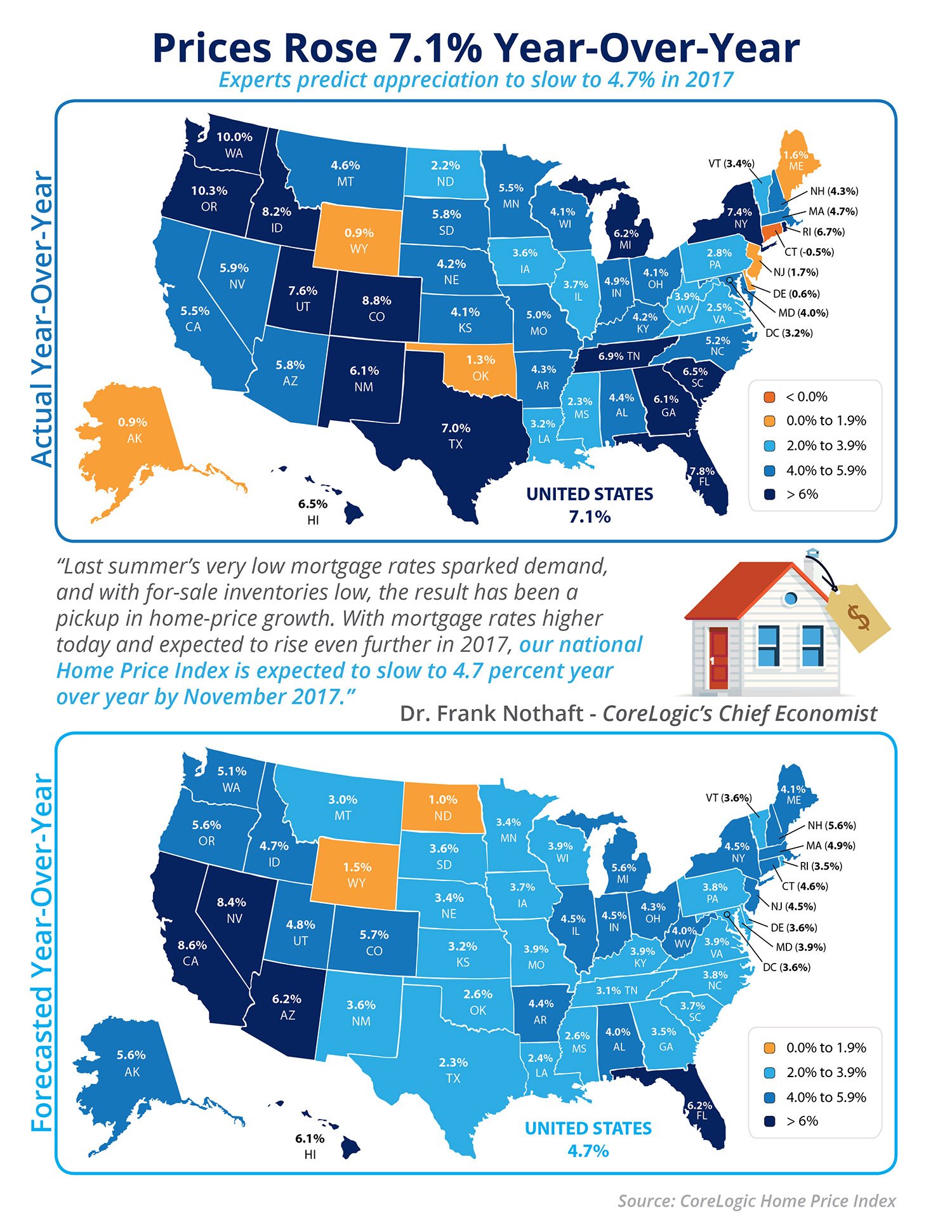
Prices Rose 7.1% Year-Over-Year [INFOGRAPHIC]

Prices Rose 7.1% Year-Over-Year [INFOGRAPHIC] | Simplifying The Market

Some Highlights:

  • CoreLogic’s latest Home Price Index shows that prices rose by 7.1% across the United States year-over-year.
  • With mortgage interest rates rising in the short term, CoreLogic believes price appreciation will slow to 4.7% by this time next year.
  • 49 out of 50 states, and the District of Columbia, all had positive appreciation over the last 12 months, with the only exception being the state of Connecticut, which experienced a -0.5% appreciation.
Prices Rose 7.1% Year-Over-Year [INFOGRAPHIC]2017-01-13T11:00:59+00:00
Go to Top