

window.dataLayer = window.dataLayer || []; function gtag(){dataLayer.push(arguments);} gtag('js', new Date()); gtag('config', 'UA-157086367-1');

About Remi Silva

This author has not yet filled in any details.
So far Remi Silva has created 1449 blog entries.

How Fast Can You Save for a Down Payment?

How Fast Can You Save for a Down Payment? | Simplifying The Market

Saving for a down payment is often the biggest hurdle for a first-time homebuyer. Depending on where you live, median income, median rents, and home prices all vary. So, we set out to find out how long would it take you to save for a down payment in each state?

Using data from the United States Census Bureau and Zillow, we determined how long it would take, nationwide, for a first-time buyer to save enough money for a down payment on their dream home. There is a long-standing ‘rule’ that a household should not pay more than 28% of their income on their monthly housing expense.

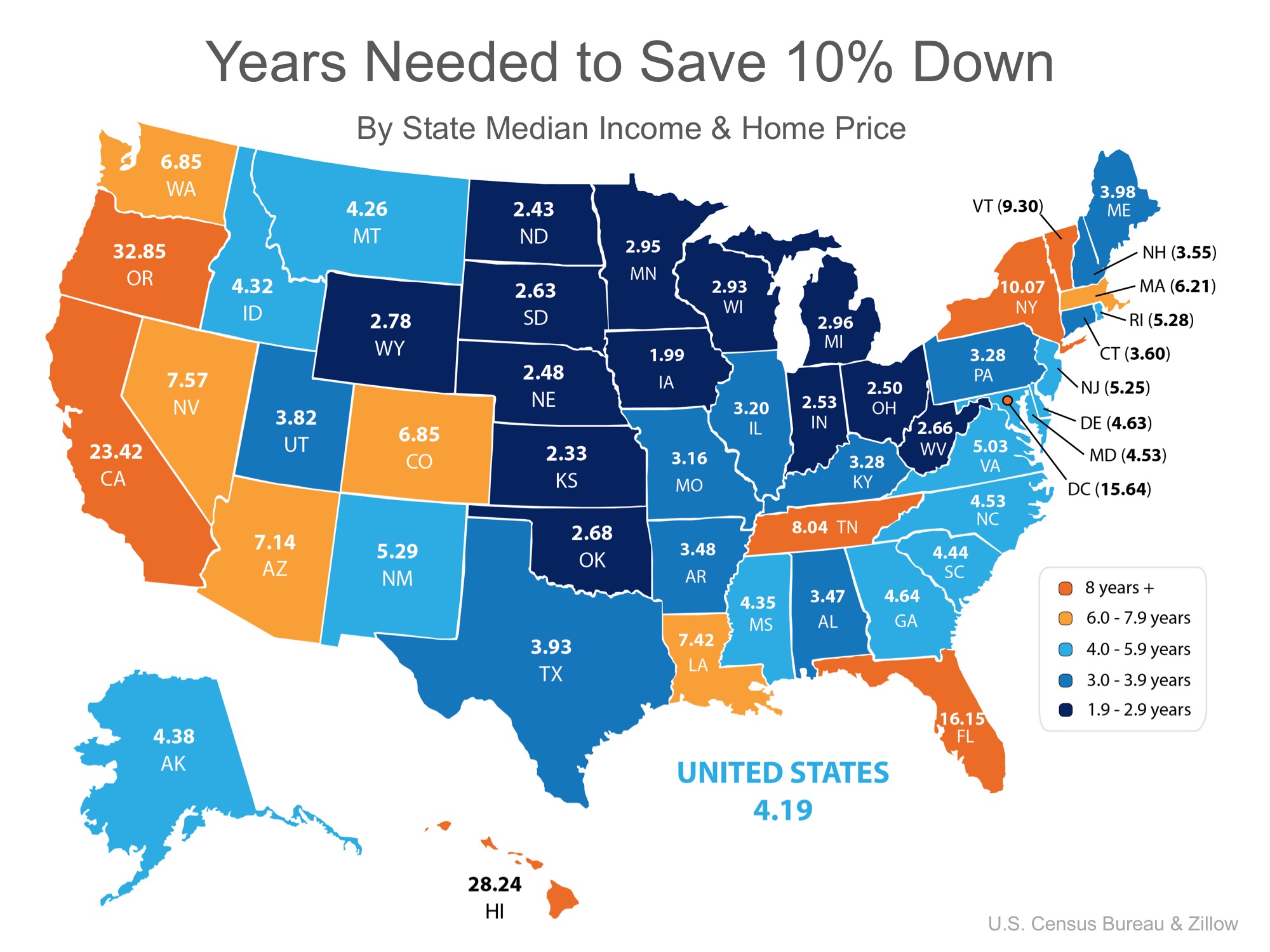
By determining the percentage of income spent renting a 2-bedroom apartment in each state, and the amount needed for a 10% down payment, we were able to establish how long (in years) it would take for an average resident to save enough money to buy a home of their own.

According to the data, residents in Iowa can save for a down payment the quickest in just under 2 years (1.99). Below is a map created using the data for each state:
How Fast Can You Save for a Down Payment? | Simplifying The Market

What if you only needed to save 3%?

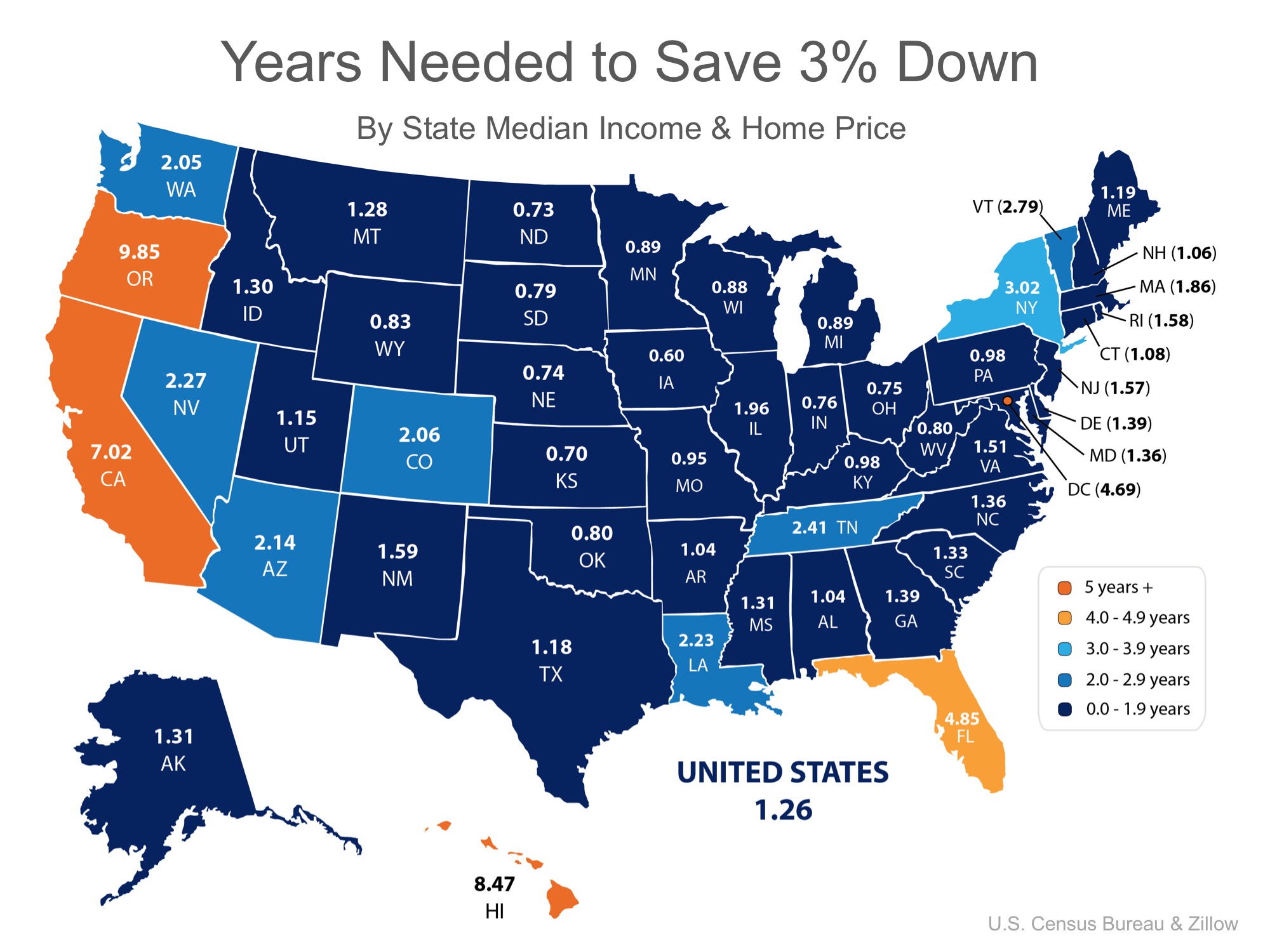
What if you were able to take advantage of one of Freddie Mac’s or Fannie Mae’s 3% down programs? Suddenly, saving for a down payment no longer takes 5 or 10 years, but becomes attainable in a year or two in many states as shown in the map below.
How Fast Can You Save for a Down Payment? | Simplifying The Market

Bottom Line

Whether you have just started to save for a down payment, or have been saving for years, you may be closer to your dream home than you think! Let’s meet up so I can help you evaluate your ability to buy today.

How Fast Can You Save for a Down Payment?2017-04-24T10:00:58+00:00

Slaying Home Buying Myths [INFOGRAPHIC]

Slaying Home Buying Myths [INFOGRAPHIC] | Simplifying the Market

Some Highlights:

  • Interest rates are still below historic numbers.
  • 88% of property managers raised their rent in the last 12 months!
  • The credit score requirements for mortgage approval continue to fall.
Slaying Home Buying Myths [INFOGRAPHIC]2017-04-21T10:00:52+00:00

Tax Return Depressing? Owning a Home Could Help

Tax Return Depressing? Owning a Home Could Help | Simplifying The Market

Many Americans got some depressing news last week; either their tax return was not as large as they had hoped or, in some cases, they were told they owed additional money to either the Federal or State government or both. One way to save on taxes is to own your own home.

According to the Tax Policy Center’s Briefing Book -“A citizen’s guide to the fascinating (though often complex) elements of the federal Tax System” – there are several tax advantages to homeownership.

Here are four items, and a quote on each, from the Briefing Book:

1. Mortgage Interest Deduction

“Homeowners who itemize deductions may reduce their taxable income by deducting any interest paid on a home mortgage. The deduction is limited to interest paid on up to $1 million of debt incurred to purchase or substantially rehabilitate a home. Homeowners also may deduct interest paid on up to $100,000 of home equity debt, regardless of how they use the borrowed funds. Taxpayers who do not own their home have no comparable ability to deduct interest paid on debt incurred to purchase goods and services.”

2. Property Tax Deduction

“Homeowners who itemize deductions may also reduce their taxable income by deducting property taxes they pay on their homes.”

3. Imputed Rent

“Buying a home is an investment, part of the returns from which is the opportunity to live in the home rent-free. Unlike returns from other investments, the return on homeownership—what economists call “imputed rent”—is excluded from taxable income. In contrast, landlords must count as income the rent they receive, and renters may not deduct the rent they pay. A homeowner is effectively both landlord and renter, but the tax code treats homeowners the same as renters while ignoring their simultaneous role as their own landlords.”

4. Profits from Home Sales

“Taxpayers who sell assets must generally pay capital gains tax on any profits made on the sale. But homeowners may exclude from taxable income up to $250,000 ($500,000 for joint filers) of capital gains on the sale of their home if they satisfy certain criteria: they must have maintained the home as their principal residence in two out of the preceding five years, and they generally may not have claimed the capital gains exclusion for the sale of another home during the previous two years.”

Bottom Line

We are not suggesting that you purchase a house just to save on your taxes. However, if you have been on the fence as to whether 2017 is the year you should become a homeowner, this information might help with that decision.

Disclaimer: Always check with your accountant to find out what tax advantages apply to you in your area. 

Tax Return Depressing? Owning a Home Could Help2017-04-20T10:00:30+00:00

Measuring Your Ability to Achieve the American Dream

Measuring Your Ability to Achieve the American Dream | Simplifying The Market

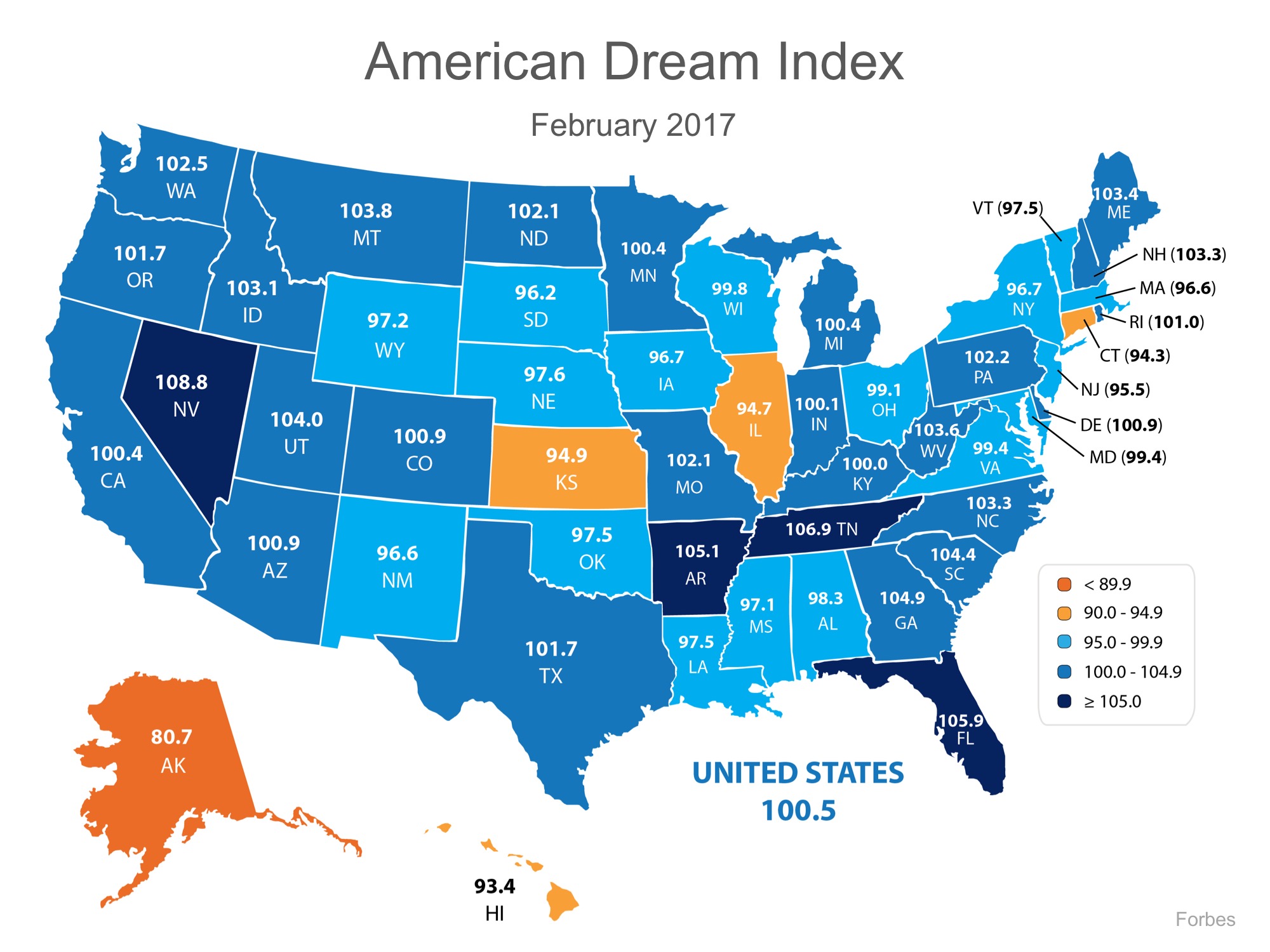
Forbes.com recently released the results of their new American Dream Index, in which they measure “the prosperity of the middle class, and…examine which states best support the American Dream.”

The monthly index measures several different economic factors, including goods-producing employment, personal and commercial bankruptcies, building permits, startup activity, unemployment insurance claims, labor force participation, and layoffs.

The national index score was rounded out to 100 in January and saw a modest jump to 100.5 in February.

Alaska represented the lowest score on the index at 80.7, due mostly to the recent collapse in oil prices. Nevada came in with the highest score at 108.8, boosted by big gains in goods-producing jobs and new construction activity. The full results can be seen in the map below.

Measuring Your Ability to Achieve the American Dream | Simplifying The Market

Forbes Senior Editor Kurt Badenhausen explained why many states saw a boost in the index last month:

“[B]usinesses are hiring in part in anticipation of tax cuts and less regulation… Many areas of the country have experienced strong upticks in employment and construction, as well as declines in unemployment claims since the start of the year.”

Bottom Line

The American Dream, for many, includes being able to own a home of his or her own. With the economy improving in many areas of the country, that dream can finally become a reality.

Measuring Your Ability to Achieve the American Dream2017-04-19T10:00:36+00:00

US Housing Market Continues the Move into ‘Buy Territory’!

US Housing Market Continues the Move into ‘Buy Territory’! | Simplifying The Market

According to the Beracha, Hardin & Johnson Buy vs. Rent (BH&J) Index, the U.S. housing market has continued to move deeper into buy territory, supporting the belief that housing markets across the country remain a sound investment.

The BH&J Index is a quarterly report that attempts to answer the question:

In today’s housing market, is it better to rent or buy a home?

The index examines the entire US housing market and then isolates 23 major cities for comparison. The researchers “measure the relationship between purchasing property and building wealth through a buildup in equity versus renting a comparable property and investing in a portfolio of stocks and bonds.” 

While most of the metropolitan markets examined moved further into buy territory (15 of the 23), markets like Dallas, Denver, and Houston are currently deep into rent territory. In these three markets, it is estimated that renting will top homeownership 7 out of 10 times.

Due to a lack of inventory, the home prices in the Dallas, Denver, and Houston, areas have increased by 13%, 11.4%, and 7.3% respectively. Home prices in these areas will begin to return to more normal levels once residents realize that renting is not the best option, therefore bringing home affordability back as well.

Bottom Line

The majority of the country is strongly in buy territory. Buying a home makes sense socially and financially, as rents are predicted to increase substantially in the next year. Protect yourself from rising rents by locking in your housing cost with a mortgage payment now. 

To Find Out More About the Study: The BH&J Index and other FAU real estate activities are sponsored by Investments Limited of Boca Raton. The BH&J Index is published quarterly and is available online at http://business.fau.edu/buyvsrent.

US Housing Market Continues the Move into ‘Buy Territory’!2017-04-18T10:00:26+00:00
Go to Top